For decades, institutional real estate firms have separated responsibility along a familiar line. Asset Managers oversee performance. Property Managers execute operations. One analyzes returns and directs strategy. The other manages the building, the team, the vendors, and the residents.
In theory, Asset Management owns the financial narrative while Property Management owns the operational one.
But that divide has created a structural flaw in how the industry uses data.
Financial data has traditionally lived at the asset level. Budgets, variances, and forecasts are reviewed by Asset Managers. Property Managers report upward, explaining what happened and why. The conversation is retrospective. Numbers are reviewed after the month closes. Variances are explained. Justifications are documented.
Rarely does the discussion focus on what is forming in real time.
What is missing is not more reporting. It is adoption of data inside Property Management itself.
The Industry’s Blind Spot
Property Managers are often elevated because they are exceptional operators. They know how to manage teams, handle vendors, resolve resident issues, and keep buildings running smoothly. They are execution oriented leaders.
But many have not been trained or empowered to think in financial terms beyond a monthly budget meeting. They review spreadsheets. They explain line items. They answer questions from Asset Management.
Spreadsheets are necessary. But they are not sufficient.
Spreadsheets are static. They show totals. They are retrospective by nature. For some professionals, they are intuitive. For many operational leaders, especially those who are visual learners, they obscure patterns rather than reveal them.
Data visualization changes that dynamic entirely.
When performance metrics are presented visually, trends become obvious. Relationships become clear. Movement becomes visible.
And that visibility belongs in Property Management, not just Asset Management.
Why Property Managers Must Adopt Data Dashboards
Property performance is not created in financial models. It is created in leasing offices, maintenance shops, vendor contracts, and daily operational decisions.
When Property Managers visualize the data tied to their daily activity, behavior shifts.
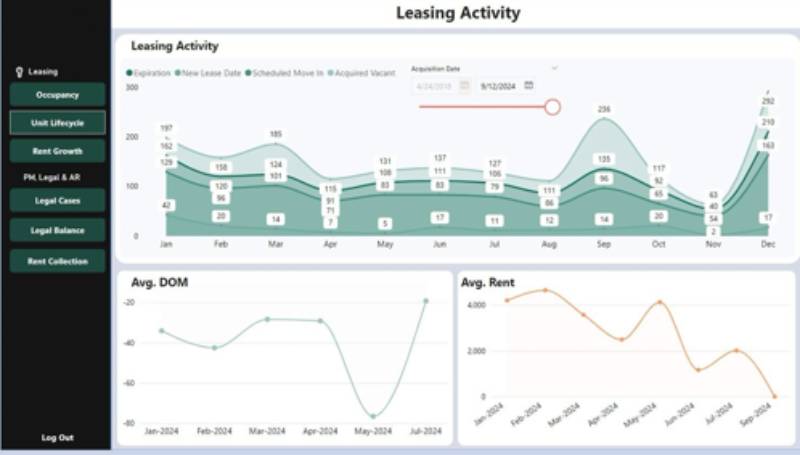
Consider leasing metrics. Occupancy and rent growth are not abstract numbers on a report. They are the lifeblood of the asset. A real time leasing dashboard can show traffic to application conversion, application to approval rates, days on market, renewal pacing, and trade out percentages. Instead of waiting for a monthly occupancy report, Property Managers can see leasing velocity slow down as it happens. They can identify whether follow up speed is dropping or pricing is misaligned with demand.
Leasing is not just about filling units. It is about filling them at the right rates. The hospitality world uses the phrase heads in beds, but the principle applies directly to property management. Occupancy at sustainable rents maintains profitability. That profitability funds payroll, capital projects, and vendor leverage. When Property Managers see these metrics in real time, leasing stops being administrative and becomes strategic.
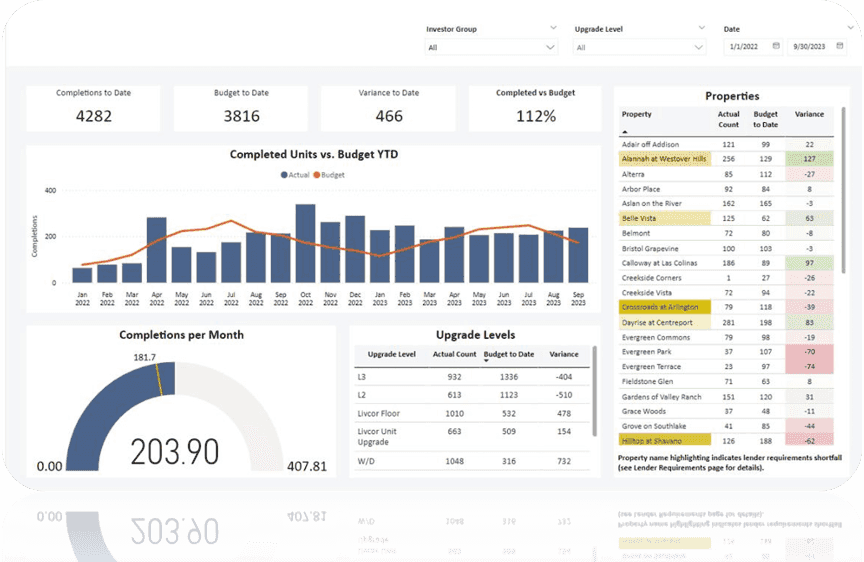
Renovation cycles are another area where dashboards transform engagement. Capital plans are often developed at the asset level, but execution delays occur at the property. A dashboard that tracks renovation timelines, cost per unit, downtime impact, and vendor performance creates accountability and visibility. If a unit sits offline for twenty eight days instead of fourteen, the financial impact is immediate and visible. Property Managers can adjust scheduling, vendor coordination, or procurement strategies before losses compound.
Turn management is equally powerful when visualized. Every day of vacancy erodes net operating income. A live dashboard that tracks notice received, inspection completion, repair progress, and ready dates exposes bottlenecks in real time. Instead of discovering vacancy loss at month end, managers can intervene mid cycle.
Maintenance data may be the most underutilized signal of all. Most systems treat maintenance tickets as logs, events recorded and closed. But when visualized, maintenance metrics reveal performance drivers. Average days to close, repeat repair frequency, cost per ticket by category, preventive versus reactive ratios, and vendor cost comparisons provide clarity that a ledger cannot. Patterns emerge. Recurring plumbing issues may signal a need for capital upgrades. Extended response times may correlate with declining renewal rates.
These are not asset level abstractions. They are property level decisions.
From Retroactive Explanation to Proactive Management
When data stays in Asset Management, Property Managers remain reactive. They explain what happened. They defend variances. They justify costs.
When data is adopted within Property Management, the conversation shifts.
Instead of asking why maintenance exceeded budget last month, the question becomes why response time is trending upward this week and how to correct it.
Instead of reviewing delinquency after it accumulates, managers can track aging trends daily and adjust collection strategies.
Dashboards convert data from documentation into direction.
They empower Property Managers to see performance forming in real time and adjust before issues escalate.
Transparency Changes Culture
There is another benefit to data adoption within Property Management, alignment.
When both Asset Managers and Property Managers view the same operational dashboards, conversations become collaborative rather than corrective. Instead of monthly variance interrogations, discussions center on trend analysis and performance improvement.
Transparency removes defensiveness. It replaces what went wrong with what are we seeing and how do we optimize it.
This is not about eliminating oversight. It is about elevating Property Managers into financially literate operators who understand how their daily decisions drive net operating income.
Elevating the Role of the Property Manager
The industry has historically rewarded field service expertise. Strong executors rise into management roles. But without real time performance visibility, even the best operators remain disconnected from financial outcomes.
Data adoption bridges that gap.
When Property Managers visualize leasing performance, renovation cycles, turn timelines, maintenance efficiency, and cost trends in a unified dashboard, they begin thinking like asset stewards.
They see how occupancy stability supports staffing.
They see how turn speed protects revenue.
They see how vendor efficiency compounds into long term savings.
Data stops being a monthly report. It becomes part of daily decision making.
The Shift That Needs to Happen
Asset Management should not be the sole owner of data interpretation.
Property Management must adopt dashboards as core operating tools. Not as decorative reports. Not as executive only views. But as daily operational instruments.
When Property Managers have clear, real time visibility into leasing, maintenance, renovation, and turn metrics, performance improves naturally. Accountability increases without micromanagement. Financial literacy grows organically.
Asset performance is not created in spreadsheets.
It is created in the field.
And the data that drives it belongs there too.
At FlowTech, we believe dashboards should not sit in executive presentations. They should sit in property offices, guiding decisions in real time.
Because property management is not separate from asset management.
It is where asset value is actually built.
By Prashanth Rayapudi
Founder, FlowTech